 |
| Marc Adamus |
Friday, April 29, 2016
Natural Landscapes Prework
Beauty as it relates to the natural world is difficult to define. However, I think beauty is when the natural world is untouched by humans; sweeping views, old growth forests, meadows, etc. are all natural creations that embody our idea of beauty.
I've been fortunate to experience my defined beauty in nature multiple times. However, the most memorable was when I went to Indonesian Borneo over the summer after my eighth grade year. I found myself in a situation where I was completely surrounded by nature. While initially uncomfortable, the tranquil beauty of the rainforest became evident. Everywhere I looked I found unique insects or pitcher plants that lined the ground and wild orangutans climbing through the trees. The heavy, stagnant air served as a reminder that we were not near the comforts of home. The discomforts of being far from home soon subsided as the overwhelming beauty of the natural landscape took over.

Urban Landscape Prework
Street Photography:
 |
| Zack Arias |
 |
| Anna Delany |
 |
| Phillip Abbott |
Quotes & Photos pulled from: http://www.complex.com/style/2012/06/the-50-greatest-street-photographers-right-now/phillip-abbot
Contemporary:
 |
| iO Tillett Wright |
 |
| Johnny De Guzman |
Historical:
 |
| Robert Capa |
Wednesday, March 30, 2016
Alfred Stieglitz
Alfred Stieglitz is considered to be one of the first fine art photographers. He is credited with making photography an "acceptable art form". Born in 1864 Stieglitz largely pioneered photography as an art form rather than a simple documentary tool. He primarily took fine art portraits.
I love this photo because of his close attention to detail and the way her hands are positioned. I like the focus on her face but then, again, the detail and positioning of her hands also commands the viewers focus creating an interesting image. The contrast, background and composition all combine to make this a fine art portrait.
I love this photo because of the composition and soft depth of field. It creates a more intimate, environmental portrait that is wonderfully composed.
 |
| Georgia O'Keefe- Alfred Stieglitz |
 |
| Heidi Stieglitz- Alfred Stieglitz |
Tuesday, March 8, 2016
Henri Cartier-Bresson
Henri Cartier Bresson was a french humanist photographer, he is often credited with being "the master of candid photography". Decisive Moment seems to be an appropriate term for his photography as his photos reflected his unique ability to capture moments where everything is interesting, or happening or compositionally perfect.
 |
| Again, Cartier-Bresson plays with juxtaposition. The destroyed walls juxtapose with the joyful children give this photo an ominous but uplifting tone that draws me to it. |
 |
| Henri Cartier-Bresson This is one of my favorite images from him, I like the whimsy in the shape of the stairs contrasted with the severity of the kids expression. This one is different than a lot of his photographs as it's more obviously posed but, still is very unique and interesting. |
Friday, March 4, 2016
Annie Leibovitz
Annie Leibovitz is arguably the most famous photographer alive, she rose to popularity as her work with Rolling Stone became more and more recognized. She eventually, however, switched to Vanity Fair. She is notable for her many beautiful, iconic photos, but also her two definitive styles. The first is her earlier journalistic works and the second her extravagant, rigidly posed work with Vanity Fair and other publications. I personally prefer the more raw and emotive characteristics of her early work with Rolling Stone. While I admire her transition to Vanity Fair and appreciate the beauty of her photos I think her most powerful photos are the more intimate ones. The one that struck me most was the one of John Lennon and Yoko Ono taken hours before his sudden death.
 |
| Annie Leibovitz |
I think the raw, intimate nature of this photo makes it stronger than many of her extravagant works. Personally, I'm drawn to raw images that may well be posed but look natural, rather than the obviously posed ones for vanity fair. I like and appreciate both but prefer her work with Rolling Stone.
I think this duality of her photos contributes to her almost universal fame. Partially the fame of her subjects but also the quality of her photos has caused her to be so famous. For example, nearly every photo showed in the film with the exception of her personal photos, I was familiar with, suggesting the wide circulation of her work.
I think this duality of her photos contributes to her almost universal fame. Partially the fame of her subjects but also the quality of her photos has caused her to be so famous. For example, nearly every photo showed in the film with the exception of her personal photos, I was familiar with, suggesting the wide circulation of her work.
Friday, February 19, 2016
Light, Shadows and Reflections Pre-work part 2
 |
| Following Directions, Michael Kenna |
This image is a silhouette with backlighting. To achieve this effect, Kenna likely metered on the sky, not the trees or the birds. I'm assuming he metered there because the grey tones are in the sky and the trees, silhouetted. The mood in this image achieved through this metering is slightly ominous, however, the brightness of the sky lends itself to a more cheerful mood. Had Kenna metered instead on the trees this image would be much less interesting, the drama of the sky would be lost and the grey tones instead would be in the trees.
Tuesday, February 2, 2016
Light, Shadows, and Reflections Pre-Work Part 1
Silhouette:
 |
| Caravan Silhouette, Laura Dunn-Mark |
 |
| One Hundred and Four Birds, Michael Kenna |
Back lit non silhouette images:
 |
| Buddha Offering, Michael Kenna |
Reflections:
 |
| Boris Pophristov |
Images where shadows are the main subject:
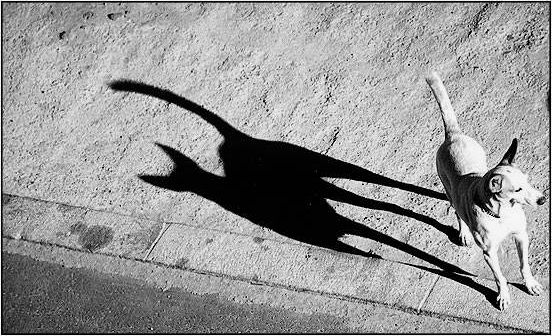 |
| Unknown |
Do you think a single photo has the ability to affect change?
 |
| Nick Ut's "Terror of War" |
I think photos absolutely have the power to enact change, I think a powerful example of this is Nick Ut's "Terror of War". While there's a lot I could say about this photo and the change it enacted, (I wrote my extended essay on it) I'll keep my report on it's impact brief. Essentially, when this photo first arrived in American living rooms via nightly news reports and newspapers it shocked the public. The already dwindling support for U.S. involvement in the Vietnam War was shaken. The photo depicts a misplaced South Vietnamese napalm strike in which innocent South Vietnamese civilians were the victims. Kim Phuc, the main girl running away, has stripped off her burning clothes as her terrified brother runs towards the camera. This photo acted as a catalyst for social and political change by further confusing the roles of the aggressors and victims for the American public. Politicians leveraged the photo to garner support and funding for hospitals, enacting both social and political change.
Monday, February 1, 2016
Margaret Bourke-White
 |
| Hats in the Garment District, New York, 1930. Margaret Bourke-White utilizes the birds eye view technique very effectively here. The high contrast, the bright whites of the hats and the overall grey tone of the photo dehumanize those in the photo, the people are reduce to simple "hats" or ants rather than humans. By doing so she creates an interesting photo and comments on society and humanity. |
Wednesday, January 20, 2016
Wednesday, January 6, 2016
Photography 3-4 Journal Assignment Exploring Depth of Field and Abstraction
A. Abstraction
1. Write out a definition of abstraction. Refer this then to abstraction in photography. Find 2 to 3 images showing what you consider abstraction in photography.
Abstraction is a jump from reality, its images are not always clear, often taking the form of colors and shapes, messages are typically intentionally ambiguous.
 |
| The Dahlias are Coming - Zeb Andrews |
 |
| Sunrise Pink - Zeb Andrews |
2. Explain how depth of field is used in these images. Do you think the photographer used depth of field to effectively enhance the abstract quality of the image?
| Both these images convey an emotion or feeling but the content of the image is ambiguous. Zeb Andrews, the photographer, utilized depth of field effectively to enhance these images beyond simple flower photos. By having such a shallow depth of field Andrews creates interesting shapes and colors create an abstract image.
B. Examples of Shallow Depth of Field
|
1. Find a photograph of a still life using shallow depth of field
 |
| Daniel Sroka - Circumspect (#279) |
2. Find a photograph of a portrait using shallow depth of field.
 |
| Once in a Blue Moon series- Zeb Andrews |
Project 3: Prework
1.Find a photograph that shows each of the following types of motion: Mount and label these
1. Panning
 |
| Mara in Monochrome series - Marlon Du Tolt |
2. Slow motion
 |
| Modern Goddess #2 - Heidi Kirkpatrick |
3. Freeze action
 |
| Sing out 2006 - Heidi Kirkpatrick |
4. Total motion
 |
| Raymond Vanzessen |
5. Effective use of camera shake
 |
| Blake Andrews |
2. Find two photographs that show the same type of action, but opposite movements.
 |
| Modern Goddess #18 2000 - Heidi Kirkpatrick |
 |
| New World 2006 - Heidi Kirkpatrick |
3. Post images of at least 2 triptychs and define what a triptych is.
 |
| Tom Spianti |
 |
| Michael Putland |
A triptych is a collection of three photos that are related, aesthetically compliment each other, or carry similar themes throughout.
Thursday, December 3, 2015
Angles, Elements, and Filters
These are my final three images for this project. While I'm not in love with the composition (I'm still adjusting to the rangefinder on my camera) of the first one, I think the print quality is very nice.
 |
| Printed at f 11 for 6 seconds with a 1 1/2 filter |
 |
| Printed at f 11 for 7 seconds with a 3 filter |
 |
| Printed at f 11 for 6 seconds with a 3 filter |
Thursday, November 19, 2015
Filter Test
For this assignment I conducted a filter test to learn further what each filter looks like when applied:


After conducting the test I printed a final image with a 3 filter at f11 for 5 seconds:

While not my favorite image compositionally I think it's printed well.
Composition Hunt
1. Line:
2. Texture:
3. Shape:
4. Space:
5. Value:
 |
| Thaly's View- Michael Kenna |
 |
| Garlic Scapes- Ray Bidegain |
2. Texture:
 |
| Desert Clouds- Michael Kenna |
 |
| Leaf After- Ray Bidegain |
3. Shape:
 |
| Pear 2013- Ray Bidegain |
4. Space:
 |
| Cross- Bill Vaccaro |
5. Value:
 |
| Aloft 1- Daniel Sroka |
Thursday, October 8, 2015
Project one: Final

For this first project I was inspired by the poem, If Only We Had Taller Been by Ray Bradbury. Just before Mariner 9 went into orbit around Mars, a panel met, composed of Ray Bradbury and scientists, including my grandfather. Bradbury shared a poem which "links the dream of conquering space with the dream of immortality."
“If Only We Had Taller Been”
" The fence we walked between the years
Did bounce us serene.
It was a place half in the sky where
In the green of leaf and promising of peach
We'd reach our hands to touch and almost touch the sky,
If we could reach and touch, we said,
'Twould teach us, not to, never to, be dead.
We ached and almost touched that stuff;
Our reach was never quite enough.
If only we had taller been,
And touched God's cuff, His hem,
We would not have to go with them
Who've gone before,
Who, short as us, stood tall as they could stand
And hoped by stretching, tall, that they might keep their land,
Their home, their hearth, their flesh and soul.
But they, like us, were standing in a hole.
O, Thomas, will a Race one day stand really tall
Across the Void, across the Universe and all?
And, measured out with rocket fire,
At last put Adam's finger forth
As on the Sistene Ceiling,
And God's hand come down the other way
To measure man and find him Good,
And Gift him with Forever's Day?
I work for that.
Short man, Large dream, I send my rockets forth
between my ears,
Hoping an inch of Good is worth a pound of years.
Aching to hear a voice cry back along the universal Mall:
We've reached Alpha Centauri!
We're tall, O God, we're tall! "
I choose this poem because it reminds me of my grandfather, but also because I think it's very powerful and speaks to more than just space travel (and I could envision a very aesthetically pleasing photogram). I interpreted this poem as man's continual dissatisfaction with the present and the desire to constantly progress. For my work I pulled literally from the poem when Bradbury mentions, "At last put Adam's finger forth, / As on the Sistene Ceiling," I used then a transparency of Adam's hand reaching out to the planets and the necklaces to represent the inherent human aspiration to "reach" for scientific gains but also materialistic desires as well. In my photogram I used the necklaces as traditional symbols of material wealth but also to add to the surrealist element in this photogram, thus the hand reaching out to these objects further suggests the societal want for material gains. I placed the poem in the middle of the image as it's the central idea of my photogram but also that Bradbury expresses what prevents us from achieving these things, so it seemed fitting to place the poem in the middle of the hand and the planets/necklaces as the barrier between these things. I thought trying to make this image appear surreal would speak to the connotation of immortality in the poem. Finally I added sand to create a galaxy appearance and, again, add an element of surrealism.
Process
I initially envisioned this photogram as a triptych or and experimented with this concept as well as a series of different exposures, before finally deciding on one 8x10.
I choose this poem because it reminds me of my grandfather, but also because I think it's very powerful and speaks to more than just space travel (and I could envision a very aesthetically pleasing photogram). I interpreted this poem as man's continual dissatisfaction with the present and the desire to constantly progress. For my work I pulled literally from the poem when Bradbury mentions, "At last put Adam's finger forth, / As on the Sistene Ceiling," I used then a transparency of Adam's hand reaching out to the planets and the necklaces to represent the inherent human aspiration to "reach" for scientific gains but also materialistic desires as well. In my photogram I used the necklaces as traditional symbols of material wealth but also to add to the surrealist element in this photogram, thus the hand reaching out to these objects further suggests the societal want for material gains. I placed the poem in the middle of the image as it's the central idea of my photogram but also that Bradbury expresses what prevents us from achieving these things, so it seemed fitting to place the poem in the middle of the hand and the planets/necklaces as the barrier between these things. I thought trying to make this image appear surreal would speak to the connotation of immortality in the poem. Finally I added sand to create a galaxy appearance and, again, add an element of surrealism.
Process
I initially envisioned this photogram as a triptych or and experimented with this concept as well as a series of different exposures, before finally deciding on one 8x10.
 |
| Examples of failed exposures, except for the middle on which is exposed properly but, the poem was upside down. |
 |
| Another series of experiments with varying level of success with exposures. |
 |
| An example of a diptych I attempted with good exposure. |
Subscribe to:
Posts (Atom)